Startup Business Models and Pricing (Startup School)
9 Business Models
There are 9 models covering all the products. You should stick to 1 of those and not try to reinvent the wheel.
- SaaS: Cloud-based subscription software
- Marketplace: Facilitates transactions between buyers and sellers
- Usage-based: Pay-as-you-go based on consumption
- Advertising: Sell ads to monetize free users
- Bio: Science-based tech companies
- Transactional: Facilitate transactions and take a cut
- Hard-tech: Lots of technical risk and long term horizon
- Enterprise: Sell large contracts to huge companies
- E-commerce: Sell products online
See https://www.ycombinator.com/library/Gh-yc-guide-to-business-models for more details.
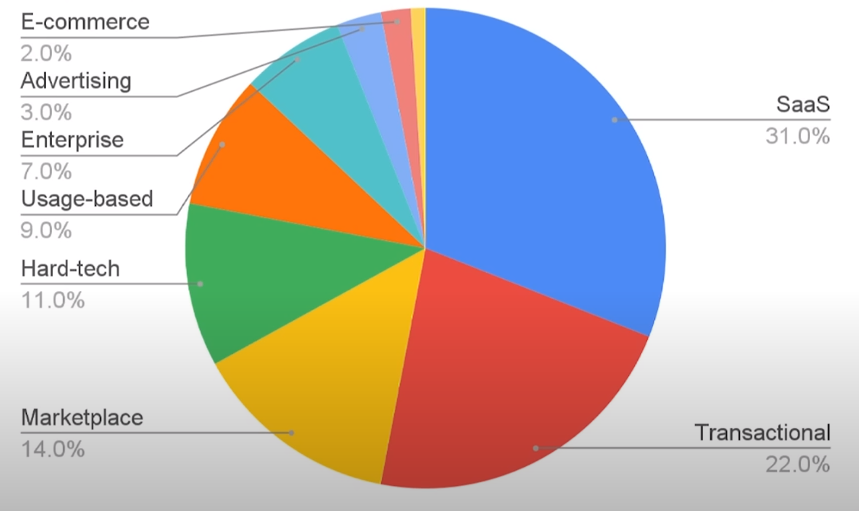
SaaS, Transactional and Marketplace cover the biggest part. And E-commerce and advertising are quite rare.
Who is not on top-100?
- Consulting business
- Non-recurring revenue, scale with people, low margin
- Affiliate business
- Too far away from transaction
- Hardware business
- Require a lot of capital, have low margin
- Business built on top of another platform
- If your business starts working, the platform will most likely kill it
Marketplaces
For recurring payments you must keep delivering value. You must have a very good Retention and otherwise people will just stop paying you.
- 95% monthly retention = 54% annual retention
- 90% monthly retention = 28% annual retention
Primary Metrics
- Gross Merchandise Value (GMV): Total sales volume transacted
- Net Revenue: Fees charged for transactions (often a % take rate)
- Growth Rate
- User Retention: % of month 1 customers that make a purchase in month 2, etc
Takeaways
- Hard to get off the ground, chicken & egg problem
- Need to scale supply and demand in sync
- Network Effect at scale drive exponential growth, organic distribution is crucial
- When they work, often become dominant winner-take-all winners
SaaS (Software as a Service)
31% of top-100 are SaaS. Customers pay until the explicitly say no, it's a very predictable option.
Primary Metrics
- Monthly Recurring Revenue or Annual Recurring Revenue (ARR)
- Growth Rate: Measured weekly or monthly
- Net Revenue Retention: % of recurring revenue retained from a prior period
- Customer Acquisition Cost
Takeaways
- All the benefits of recurring revenue
- Can have non-recurring revenue, but don’t include in ARR/Monthly Recurring Revenue
- Usually sold to businesses, ideally on annual contracts
- Growth can be driven by direct sales, self-serve acquisition channels, or both
Advertising
Only 3 of 100 YC are advertising, advertising businesses need organic virality. You should not use ads unless you're in top-10 websites on the internet.
Primary Metrics
- Daily Active Users: Unique users active in a 24 hour period
- Monthly Active Users (MAU): Unique users active in a 28 day period
- User Retention: % of active users on D1/7/30/etc
- CPM (Cost Per Thousand) or CPC (Cost Per Click)
Takeaways
- Typically consumer social products with huge scale
- Customer is the advertiser, not the end user
- Users are the product being sold
- Need billions of impressions each month
- Registered Users is a vanity metric
Pricing tips
You must charge
- You test if your users are willing to pay
- You find out which users are most willing to pay, it gives you a good signal what to focus on
- You learn how much to charge
- Even if you don't get any payments it's still good — you learn you are charging either wrong people or the product is not valuable enough
- People don't have a good understanding on the value of your product, the price is a good first impression for them — the higher the price, the better people think of your product.
How to start?
Don't spend too much time on figuring out the price, just find the right order of magnitude.
- If your customers are willing to pay 100 and you charge 10, then it's bad, but if they are going to pay 15 and you charge 10, you're good.
- Pricing can always change
Price on value, not on cost
There are 3 components:
- Cost — what it takes you to build a product
- Price
- Value — what customers see in your product
You shouldn't start from cost + pricing, it ignores the value.
If your cost is lower than the value — you shouldn't start launching.
How to find value?
- Talk to users: ask "what are the problems that you are hoping our product can solve?". The responses are usually:
- Make more money
- Reduce costs
- Move faster
- Avoid risk
- Keep incrementally increasing prices. Ideal prices is when customers complain but still pay. If you charge a price and they instantly agree — you are certainly undercharging.
- If you say "we are the same as our competitor but we're cheaper" — that's a bad idea, they can outprice you from the market.
What if users don't pay more?
- You need to build more value into your product. Price is higher than the value people see in your product.
- You need to solve a bigger problem. You should move to another problem.
- Give a lower price in exchange for:
- Your first user
- A valuable logo
- If you get lock-in
- Renew at a higher price
How to raise prices
It's relatively painless to increase the prices.
- Raise only for the new users.
- Give advance notice.
Keep it simple!
Don't add 5 pricing plans, it results in decreased conversion rate. Don't create friction from customers using your product.
Use a few very clear pricing plans.